Red Flags When Choosing a Roofing Contractor in Virginia
Most people hire a roofer once or twice in their lives, usually under pressure, often after a storm. That combination is exactly what unreliable contractors rely on. You are making a large decision quickly, about work you cannot easily inspect, in a trade where the difference between good and bad workmanship stays hidden until the first heavy rain.
The short version: be wary of anyone who arrives uninvited after a storm, pressures you to sign the same day, asks for a large cash deposit up front, cannot produce a Virginia contractor license and proof of insurance, or offers to cover your deductible. Any one of those is a reason to slow down. Two or more together is a reason to stop.
We have been roofing in the Shenandoah Valley since 1984. Below is what we would tell a neighbor to watch for, along with what a legitimate contractor does differently.
The Red Flags at a Glance
If you recognize several of these in the same conversation, that is your answer.
| Red flag | What it usually means | What to do |
|---|---|---|
| Storm knock with no local address | Out of area, chasing damage | Take the card, call local firms yourself |
| Pressure to sign today | The offer will not survive scrutiny | Get two more estimates |
| Large deposit demanded up front | Cash flow problem, or worse | Ask what it buys, in writing |
| Cash only, or a discount for cash | Avoiding a paper trail | Decline and pay traceably |
| No license number offered | Not licensed for the work | Verify with the state before signing |
| Offers to cover your deductible | Insurance fraud, and you are party to it | Walk away |
| No written scope, only a total | Nothing to hold them to later | Require an itemized estimate |
| Out of state plates and no local address | No recourse once they leave | Choose someone who lives here |
None of these are about a contractor being small or new. A one-truck local roofer with a license, insurance and a written scope is a perfectly good choice. These are about accountability.
The Storm Chaser Problem
After a significant storm, crews often arrive from out of the area to work the damage. Some are competent. The structural problem is that they are gone before their work has been tested by a season of weather, and a warranty from a company with no local presence is a piece of paper rather than a promise.
The pattern is consistent enough to recognize.
- They come to you. A knock on the door is not the red flag by itself, since legitimate local contractors canvass after storms too. Pressure to sign on the spot, a demand for payment up front and no local address are.
- They offer a free inspection and find damage immediately. A free inspection is normal. Finding significant damage on every house on the street is not.
- They want to handle the insurance claim for you. Helping document damage is normal and useful. Taking over the claim is not.
- The address on the paperwork is a PO box, or out of state. Ask where their office is and whether you could visit it.
- They cannot name local jobs. A roofer who has worked here for years can point at roofs.
The test that cuts through it: ask who you would call in three years if something goes wrong, and whether that person will still be in Augusta County. Watch how the answer lands.
Pressure, Deadlines and Prices That Expire
Urgency is the most reliable warning sign in the trade, because it exists to prevent you from comparing.
Real roofing has real timelines. A roof with an active leak needs attention quickly, and that is legitimate urgency about the roof. What is not legitimate is urgency about the signature: a price that is only good today, a crew that happens to be in the neighborhood so the job is cheaper right now, a discount that disappears if you get another quote.
A genuine estimate holds long enough for you to think. Material costs do move, so an estimate that is valid for a stated period is reasonable and normal. An estimate that expires at the end of the conversation is a sales tactic.
The best defense costs nothing: get three written estimates. Not to find the cheapest, but because three estimates make an outlier visible. If two contractors describe the same problem and the third describes something much larger, you have learned something important.
Money: Deposits, Cash, and Insurance Games
How a contractor wants to be paid tells you a great deal about how they operate.
A modest deposit to cover materials is normal on a large job. A demand for half or more of the total before anyone sets foot on the roof is not, and a contractor whose business depends on your deposit to buy materials is a contractor with a cash flow problem you are about to inherit.
Cash-only arrangements, or a meaningful discount for paying cash, should end the conversation. The discount is not for you. It exists to avoid a record, and without a record you have no receipt, no proof of the contract, and no realistic path to enforcing a warranty.
The most serious one is the deductible offer. If a contractor offers to waive, absorb or cover your insurance deductible, they are proposing to defraud your insurer, usually by inflating the claim to make up the difference. That is not a favor to you. It is a fraud you are being made party to, and it can invalidate your claim and your coverage. Walk away, and do not feel awkward about it.
Paperwork That Should Exist
Every legitimate roofing contractor in Virginia can produce these without hesitation. Asking is not rude, and the reaction to being asked is informative in itself.
- A Virginia contractor license number. You can verify it with the state's professional regulation board. A contractor who is vague about this is telling you something.
- Proof of general liability insurance, current, and ideally sent directly from their insurer rather than as a photocopy.
- Proof of workers compensation coverage. This one protects you specifically. If an uninsured worker is injured on your roof, the exposure can land on your homeowners policy.
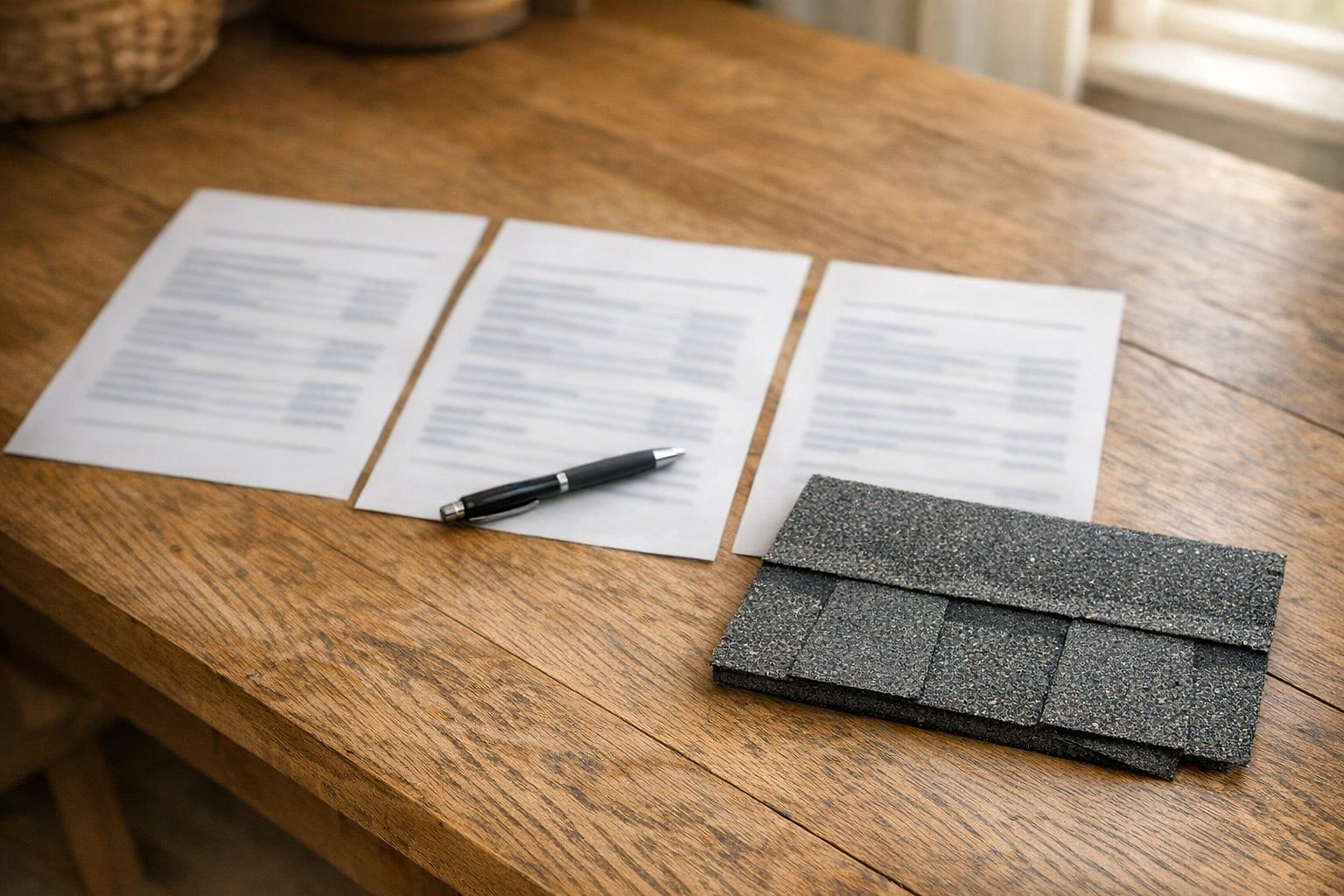
- A written, itemized scope of work naming materials, the extent of tear-off, decking allowances and disposal.
- Warranty terms in writing, with the distinction between the manufacturer's material warranty and the contractor's workmanship warranty made clear.
- Manufacturer credentials, if claimed. Certifications are verifiable. If someone claims one, it can be checked.
The workmanship warranty is the one homeowners most often misunderstand. A shingle manufacturer warrants the shingle against defects. It does not warrant that your contractor installed it correctly, and installation error is what causes most premature roof failures. Those are two separate documents and you want both.
The Insurance Angle, Specifically
Storm damage is where the largest sums move and where the worst behavior concentrates, so it is worth being precise about how this should work.
A good contractor inspects your roof, documents what they find with photographs, and gives you a written assessment of the damage and what repairing it involves. You then use that to make an informed decision about whether to file a claim. You file it. You talk to your adjuster. Your contractor can meet the adjuster on site and explain what they found, which is genuinely useful, but the claim remains yours.
What should worry you is a contractor who wants to run the claim, who asks you to sign something assigning them your insurance benefits before any inspection has happened, or who tells you the work will cost exactly whatever your insurance pays regardless of what the job actually involves.
Getting an independent inspection before you contact your insurer is the single most useful thing you can do. It means you know what happened to your roof before anyone else characterizes it for you. We offer free inspections for exactly this reason, and our guide to filing a storm damage roof claim in Virginia walks through the sequence.
What a Good Contractor Does Instead
It is easier to spot problems when you know what normal looks like.
- They get on the roof. A diagnosis from the driveway is not a diagnosis.
- They show you photographs of what they found, rather than describing it.
- They explain what is urgent and what is not. A contractor who tells you something can wait until spring is demonstrating that they are not simply maximizing the job.
- They put it in writing before asking for anything.
- They answer the awkward questions about license, insurance and warranty without becoming defensive.
- They are reachable afterwards. The number still works, and someone answers it.
Why Valley Homeowners Call Baber
We have been roofing in the Shenandoah Valley since 1984, which is more than forty years and three generations of the same family. The practical significance is accountability: we are still here, and the roofs we installed a decade ago are on houses we drive past.
- GAF Master Elite certified. Worth explaining rather than just naming. GAF awards it only to contractors who are properly licensed and insured, who hold a documented record of quality installation, and who maintain that standing year to year. Fewer than two percent of roofing contractors in the country qualify, and it is what allows us to offer the enhanced warranty coverage GAF reserves for those contractors.
- 25-year workmanship warranty on GAF shingle roofs (10 years on metal roofs). In writing, and separate from any manufacturer coverage on the materials themselves.
- Free roof inspections, including for storm damage, with photographs of what we find.
- Financing available, so a roof that needs doing properly does not become a decision made purely on what is affordable this month.
- Two Valley locations, covering Staunton, Waynesboro, Fishersville, Stuarts Draft, Verona and Augusta County. We are local to the work rather than passing through it.
Talk to a Roofer Who Will Still Be Here
If you are weighing estimates and something about one of them is bothering you, that instinct is usually worth listening to. A second opinion from a local contractor costs nothing and settles it either way.
Call our Staunton office at (540) 885-6514 for a free roof inspection. We will get on the roof, photograph what we find, tell you what needs doing now and what can wait, and put it in writing. You can also read our guide to finding a top-rated roofing contractor in Augusta County.
Frequently Asked Questions
What are the biggest warning signs of a bad roofing contractor?
A storm knock from a crew with no local address, pressure to sign immediately, large up-front cash deposits, no verifiable Virginia license or insurance, no written itemized scope, and any offer to cover or waive your insurance deductible. That last one is proposing insurance fraud and should end the conversation.
Should a roofing contractor ask for a large deposit up front?
A modest deposit toward materials is normal on a large job. A demand for half or more of the total before work begins is not, and it often signals a cash flow problem. Ask specifically what the deposit covers and get that in writing before paying anything.
Is it legal for a roofer to cover my insurance deductible?
No. A contractor offering to waive, absorb or pay your deductible is generally proposing to defraud your insurer, usually by inflating the claim to compensate. It can invalidate your claim and put your coverage at risk, and it makes you a party to the arrangement. Decline and use someone else.
How do I check if a roofing contractor is licensed in Virginia?
Ask for the license number and verify it directly with Virginia's professional regulation board rather than accepting a document at face value. Also request current proof of general liability insurance and workers compensation coverage, ideally sent from the insurer rather than as a photocopy.
Why does workers compensation insurance matter to me as the homeowner?
Because if an uninsured worker is injured on your roof, that liability can end up reaching your homeowners policy. Confirming the contractor carries current workers compensation coverage protects you, not just their crew, and it is a standard thing to ask about.
What is the difference between a material warranty and a workmanship warranty?
A material warranty comes from the shingle manufacturer and covers defects in the product. A workmanship warranty comes from the contractor and covers how the roof was installed. Most premature roof failures are installation problems rather than product defects, so you want both, in writing.
Should I always choose the cheapest roofing estimate?
No, and the useful reason is that a dramatically lower estimate usually differs in what it excludes rather than in price alone. Look for missing decking allowances, unnamed materials, no disposal, and no warranty terms. Get three estimates so an outlier in either direction becomes visible.