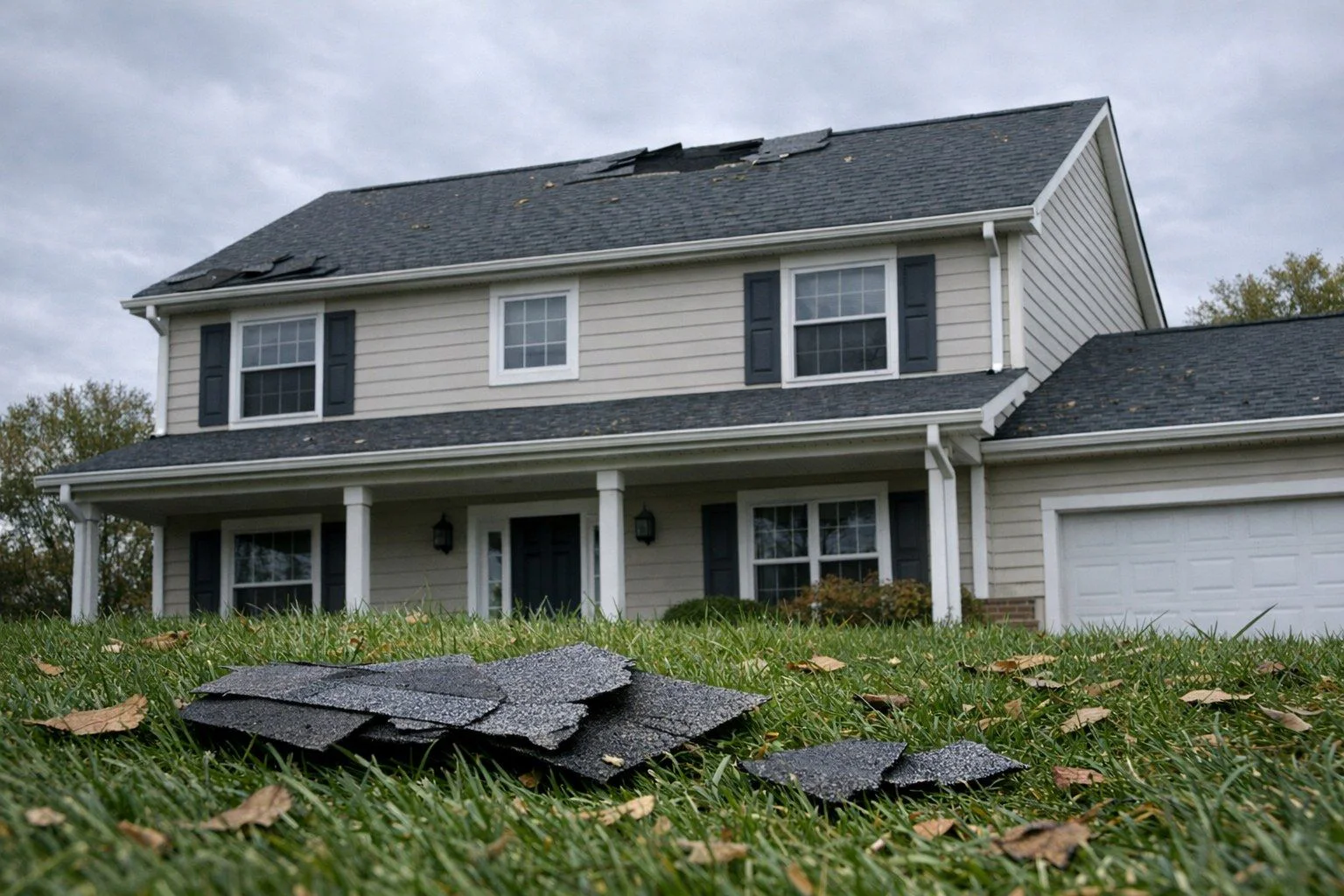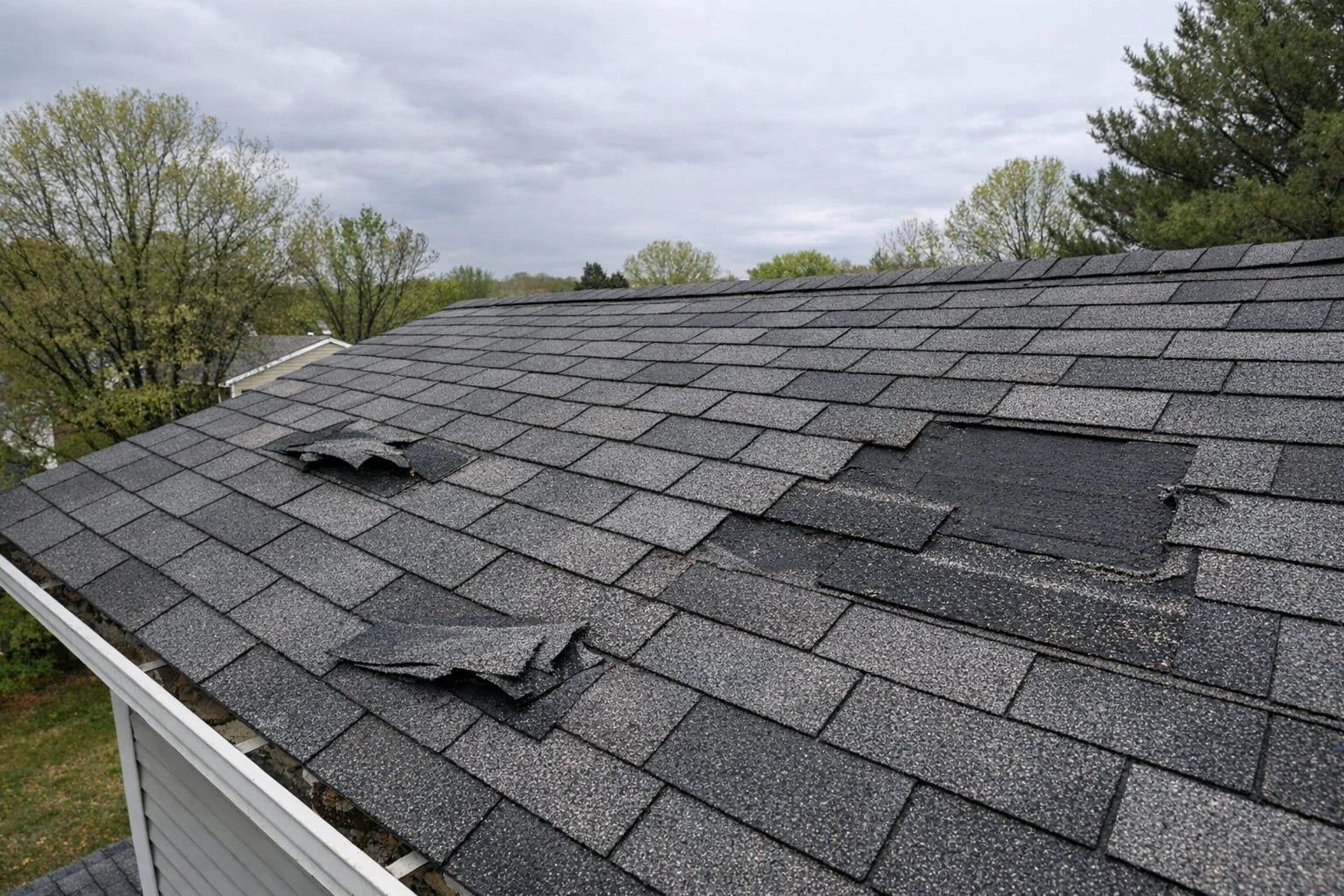

The roof insurance adjuster process starts when your insurer sends an adjuster to inspect the damage and write a scope of loss, the document your payment is built on. Before that visit, document the damage, book a free roof inspection, plan to be home, and then read the scope line by line.
Virginia's claim rules give your insurer set deadlines, and you can ask for another look if something is missed. But the adjuster works for the insurer, and hail or wind damage on an older roof can be read as age and wear. Whether you live in Staunton, Waynesboro or Harrisonburg, it helps to have your own record of the damage first.
At Baber Enterprises, we offer free roof inspections, and you can book one before the adjuster visits. Our storm damage roof repair crews handle the repair once your claim is settled.
The roof insurance adjuster process, stage by stage
A roof claim moves through five stages, and Virginia's claim settlement rules put deadlines on your insurer at two of them.
| Stage | What happens | What you do | Virginia rule or Baber fact |
|---|---|---|---|
| 1. Report the claim | You notify your insurer and get a claim number | Note the claim number and your contact | Insurer must acknowledge within 15 calendar days (14VAC5-400-50) |
| 2. Before the visit | The insurer schedules an adjuster | Take dated photos, keep receipts and damaged pieces, book a free roof inspection | We offer free roof inspections and tarping during normal hours |
| 3. Adjuster inspection | The adjuster checks the roof, gutters, vents and flashing | Be home, show interior leaks, share your photos | Our hail inspections are documented with marked test squares |
| 4. Scope and decision | The adjuster writes a scope of loss and the insurer decides | Check every line item against your documentation | Decision within 15 calendar days of proof of loss, or an explanation; written status every 45 calendar days; written denials citing the policy (14VAC5-400-60, -70) |
| 5. Disagreement | Damage was missed or the claim was denied | Get the reason in writing, ask for a re-inspection, check your policy for an appraisal clause | The State Corporation Commission's Bureau of Insurance as a last step |
What does an insurance adjuster actually do on a roof claim?
An insurance adjuster inspects the damage on the insurer's behalf, decides what the storm caused, and writes the scope of loss your payment is based on. Staff or independent, the adjuster works for the carrier, not for you. Virginia's claim rules require a fair and reasonable offer when coverage is not in dispute, and the scope is where that amount takes shape.
Claims go wrong here for plain reasons:
- Damage missed from the ground. Hail bruises and lifted shingle tabs are hard to see without walking the roof.
- Storm damage read as wear. On a roof with some years on it, granule loss from hail can be put down to age.
- Nobody home. Interior stains, attic leaks and dented gutters can be left out when no one points them out.
- Busy adjusters. After a storm crosses Augusta County and Rockingham County, adjusters may have many roofs to see in a short window.
The scope can only include what was seen and recorded. Policy basics, such as covered perils and actual cash value versus replacement cost, are in our guide to storm damage roof insurance claims.
What should you do before the adjuster arrives?
Before the adjuster arrives, build your own record of the damage and get a trained second look at the roof, because what you hand over shapes what gets checked. Have these ready:
- Photos and video. Shoot from the yard and inside the house, including ceiling stains, wet attic insulation and shingle pieces in the grass. Keep the original files so the dates stay attached.
- Dated receipts. Keep receipts for tarps, buckets, plastic sheeting or anything you paid to stop water getting in.
- Damaged material. Hold on to fallen shingles, bent vent caps or pieces of gutter until the adjuster has seen them.
- A free roof inspection. We offer free roof inspections, and our hail inspections are documented with marked test squares, so there is a record of the roof surface itself.
- Temporary protection. If water is getting in, we offer tarping during normal hours once the weather has cleared. Our crews do not go up at night or during a storm, because it is not safe.
On an open claim, check with your insurer before any permanent repair so the adjuster still has damage to see.
How long does your insurer have to respond in Virginia?
In Virginia, your insurer has 15 calendar days to acknowledge your claim and, after a completed proof of loss, 15 calendar days to accept or deny it or explain the delay. The deadlines come from the state's Rules Governing Unfair Claim Settlement Practices, 14VAC5-400, and apply statewide, from Staunton to Charlottesville:
- Acknowledgment: the insurer must acknowledge your claim within 15 calendar days (14VAC5-400-50).
- Decision: within 15 calendar days of receiving a properly executed proof of loss, the insurer must accept or deny the claim, or explain why it needs more time (14VAC5-400-60).
- Status updates: while the investigation stays open, you are owed a written status every 45 calendar days.
- Denials: a denial must be in writing and name the policy provision it relies on (14VAC5-400-70).
The decision clock runs from the proof of loss, not the storm, so ask your insurer what it needs from you. Keep a dated log of every call, email and letter.
What happens during the adjuster inspection, and should your roofer be there?
During the inspection, the adjuster usually walks the roof, checks each slope for hail and wind damage, and looks at what else the storm could have hit. Having a roofer there can help, as long as the roofer's role is to point out and document damage rather than negotiate. What gets checked:
- Hail test squares. A marked section of a roof slope where hail hits are counted and photographed, so damage can be compared slope by slope. Our hail inspections are documented this way.
- Wind damage. Creased, lifted or missing shingles, often along edges, ridges and the slopes that faced the storm.
- Collateral damage. Dents in gutters, downspouts, vents and flashing that help show hail size and direction.
On the roofer question, Virginia law draws a line. Under Va. Code 38.2-1845.1, negotiating, adjusting or advising a policyholder on a claim for compensation is public adjusting, which is licensed work. A roofer on site can show test squares, photos and measurements; the claim is settled between you and your insurer. Our crews live in the communities they work in, from Fishersville to Bridgewater, and we have installed 2,000+ roofs in the past five years.
How do you read the adjuster's scope of loss?
Read the scope of loss one line at a time against your own photos and inspection notes. It usually lists work and materials item by item, then subtracts depreciation and your deductible. Check these:
- Every damaged slope. Not just the front, or the side that faced the storm.
- Line items. Look for tear-off, underlayment, drip edge, ridge cap, vents, flashing and gutters wherever your documentation shows damage.
- Deductible. Confirm the amount matches your policy declarations page.
- Depreciation. If your policy pays replacement cost, part of the payment may be held back until the work is finished; your policy says how.
- Code items. Work required by building code may or may not be covered, depending on your policy.
For planning, our published ranges are $300 to $2,000 for common repairs and $8,000 to $20,000 or more for a full asphalt shingle replacement. If a scope for a hail-damaged roof in Waynesboro lands far below what the damage looks like, question it before work starts.
What if the adjuster missed damage or denied the claim?
If the adjuster missed damage or the claim was denied, get the reason in writing, then ask for another look with documentation that answers it. Virginia's claim rules require a denial in writing that names the policy provision it rests on. A sensible order:
- Get the reason in writing. If you only heard it on the phone, ask for the letter.
- Request a re-inspection. Ask your insurer in writing to send the adjuster back, or a different one, with dated photos and test square records attached. Whether it agrees depends on the insurer and your policy.
- Ask to add missed items. If the scope left out a slope, gutters or vents, ask the insurer to add them; this is often called a supplement.
- Check for an appraisal clause. Some policies include an appraisal process for disagreements over the amount of loss, on terms set by the policy.
- Contact the regulator. As a last step, you can contact the State Corporation Commission's Bureau of Insurance, the state agency that regulates insurers in Virginia.
How does the adjuster process work for commercial buildings and HOAs?
For commercial buildings and HOAs, the steps are the same, but the documentation has to work for an owner or board as well as the carrier. We work with building owners, property managers, and HOA boards and management companies. What matters here:
- A written scope. A board or owner needs a written scope it can set beside the adjuster's, line by line.
- Work scheduled around tenants. Inspections and repairs planned so tenants and residents can keep using the building.
- Damage documented for the carrier. Photos and notes organized by building and roof section, so each one can be matched to the scope.
- The right roof types. We do flat commercial roof repair on flat and low-slope roofs, and we install standing seam and commercial metal roofs.
For an association, an early question is whose policy covers the roof, the association's or each owner's, and the governing documents usually answer that.
What will the claim cost you, and how do you cover the gap?
Out of pocket, you pay your deductible plus anything outside the insurer's scope, and financing can cover that gap. From 1 January 2027, Virginia's Residential Property Owners Protection Act bars contractors from paying, waiving or rebating a deductible, so it stays yours to pay. The gap usually includes:
- Your deductible, set by your policy.
- Upgrades you choose, such as a different shingle line or metal in place of shingles.
- Work the adjuster did not tie to the storm, such as older wear.
For the difference, we offer financing through ContractorLoan PRO, powered by Momnt, inside the Roofle instant quote tool; details are on our roof financing page. An instant quote is a price range subject to measurement or site verification, not a final price. Warranty matters when you compare bids: our 25-year workmanship warranty is the GAF Golden Pledge warranty on shingle roofs only; metal roofs carry a 10-year workmanship warranty.
What a Virginia roofer can and cannot do in your claim
A Virginia roofer can inspect, document and repair your roof, but cannot negotiate your claim and, from 2027, cannot cover your deductible. Those limits are the quickest way to spot a door-knocker after a storm. Watch for a contractor who:
- Offers to cover your deductible. From 1 January 2027, contractors may not pay, waive or rebate it under Va. Code 59.1-618 and 59.1-619.
- Says they will negotiate with your insurer. Negotiating or advising on a claim for compensation is public adjusting under Va. Code 38.2-1845.1, which takes a license.
- Skips the paperwork. From 1 January 2027, roofing contracts tied to an insurance claim need set written notices and an itemized good faith estimate under Va. Code 59.1-618.
- •Pushes you to sign fast after a declared emergency. From 2027, on contracts signed within 180 days of a Governor's emergency declaration, owners will have 10 days to cancel under Va. Code 59.1-619.
Where we stand: we are licensed and insured in Virginia and have been in business since 1984. We document the damage and repair the roof, from Staunton to Dayton; the claim decisions stay with you and your insurer.
Book a Free Roof Inspection in Staunton Before the Adjuster Visits
Call our Staunton office at (540) 885-6514 to book a free roof inspection before your adjuster's visit. When you call, we set up the inspection, document what we find, using marked test squares on hail inspections, and explain what it means for your roof.
We are family owned and in our third generation, with 40+ years in business since 1984. We are GAF Master Elite certified, which means we have a contractor certification from GAF, a roofing manufacturer, that under 2% of contractors hold. We carry a BBB A+ rating and a 4.8 rating, and financing is available.
We serve Staunton, Waynesboro, Fishersville, Stuarts Draft, Verona, Augusta County, Charlottesville and Crozet, and we offer roofing in Harrisonburg and Rockingham County, including Bridgewater, Broadway and Dayton.
Short answers to common questions about the adjuster visit.
Frequently Asked Questions
Do I have to be home for the adjuster?
It depends on your insurer, but it is worth arranging. You can let the adjuster into the attic, point out ceiling stains and hand over dated photos. Damage inside the house is easy to miss if nobody shows it.
Can my roofer talk to the adjuster for me?
A roofer can talk with the adjuster about the damage and show test squares and photos. Negotiating or advising you on the claim amount is public adjusting under Virginia law, which takes a license. The settlement stays between you and your insurer, or a licensed public adjuster if you hire one.
How long does Virginia give my insurer to decide?
Under 14VAC5-400, your insurer must acknowledge the claim within 15 calendar days. Within 15 calendar days of a properly executed proof of loss, it must accept or deny the claim or explain why it needs more time, and it owes you a written status every 45 calendar days while the investigation is open.
Can I ask for a second adjuster inspection?
Yes. Ask your insurer for a re-inspection in writing and include dated photos and any test square records the first adjuster did not see. Whether the insurer agrees depends on the insurer and your policy. If it denies the claim, Virginia rules require the denial in writing, naming the policy provision.
Will a roofer pay my deductible?
A roofer should not. From 1 January 2027, Virginia's Residential Property Owners Protection Act bars contractors from paying, waiving or rebating a deductible, so an offer to cover it is a reason to look harder at that contractor. If the deductible is hard to cover at once, financing can spread the cost.